
NARRATIVE AS A FORCE OF COMMUNICATION
GABBY PICCIRILLI:
MASTER'S CAPSTONE
I see storytelling as a form of power, one that shapes perception, identity, and culture. My work bridges PR and creative writing to explore how narratives move through the world and the ethical responsibility behind them.
01 about me
GABBY PICCIRILLI

I am driven by illuminating the stories within people and organizations so that everyday audiences can understand, trust, and feel inspired by them.
That’s my why, and it drives everything I do, professionally and academically.
I'm a creative and strategic communicator pursuing my Master of Arts in Communication and a graduate certificate in Strategic Communication at Villanova University, where I also earned my Bachelor of Public Relations & Advertising, summa cum laude, with minors in Creative Writing and Writing & Rhetoric.
I’m passionate about narrative in all its forms, whether I’m shaping brand stories, crafting press materials, or writing fiction. Across my experiences in agency, nonprofit and consumer-focused workplaces, I have brought a detail-oriented, thoughtful approach to every project, balancing creativity with clarity and purpose, and look forward to continuing to do so in new contexts.
My goals include establishing a career in public relations or advertising while continuing to build my body of creative work and pursuing my long-term dream of becoming a published novelist.
PERSONAL STATEMENT
I never thought of myself as a “communicator.” I was always a writer, comfortable in private, alone with the page and my thoughts. I could never picture myself delivering a compelling pitch or serving as the spokesperson for a company. Growing up, every teacher I’d ever had, or any adult who spoke to me long enough, told me the same thing: slow down. I spoke too fast, too nervously, too much.
So when I was named valedictorian of the Class of 2021 and asked to deliver our commencement address, I felt more exposed than honored. I wrote the speech obsessively, line by line, breath by breath, trying to control the very thing I had always struggled with: being heard. My class had missed so much of high school, and we were graduating in caps, gowns and blue surgical masks. I had to speak for all of us. I had to make us believe we would be okay.
But when I stepped up to the podium and began, something shifted. I wasn’t just reciting words, I was connecting. I spoke with conviction, with emotion. When I finished, I looked out at a crowd visibly moved. Strangers approached me afterward to say the speech had made them cry, that it had captured something they hadn’t been able to articulate themselves.
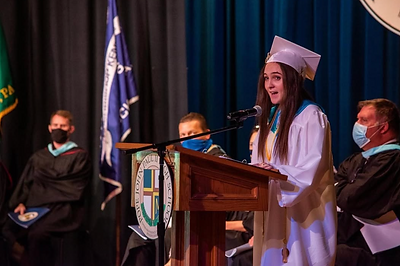
That moment redefined communication for me. I had thought it belonged to people who spoke slowly, confidently, perfectly, or those who always knew what to say aloud without writing it down first. But standing there, I realized it belongs to anyone willing to make meaning public. Communication is about translating experience into something others can feel, understand, and carry with them, much like the creative writing I’ve always felt comfortable with. Since then, my academic and professional work has been guided by a clear purpose: to illuminate the stories within people and organizations so that audiences can trust, connect with, and feel inspired by them.
To me, communication is not just a tool or academic pursuit, it is how we construct the world itself. Though often dismissed as an easy field by those who misunderstand it, few industries or social structures could exist without it. Communication is foundational. How we communicate, to whom, and about what shapes what is seen, valued, and understood. To name something is to assign it value, purpose, and expectation. In this way, communication both mirrors and constructs reality.
I’ve come to view communication as inherently ethical. The words we use can clarify or obscure, empower or exclude, humanize or reduce. My approach is grounded in an awareness of that responsibility, one that Villanova’s graduate program has both deepened and refined. I am particularly drawn to working with narratives that have been oversimplified, misrepresented, or overlooked, especially where storytelling shapes public understanding of complex emotional or social experiences. Whether through academic research or professional practice, my goal is to contribute work that meets expectations by gaining visibility or generating sales, but also manages to make a tangible difference and resonate on a more meaningful level.
Earning my master’s has significantly sharpened my development as a communication scholar. While I earned my undergraduate degree in the same discipline, my graduate studies have deepened my understanding of what communication is and what it can do. I entered the program with a strong applied foundation; I could write press releases, craft pitches, build media lists, develop advertising campaigns, and evaluate PR and advertising strategies. Yet through my master’s coursework, I was pushed to examine what lies beneath those practices, making my work more thoughtfully grounded in theory.
Through qualitative, quantitative, and rhetorical research, I stepped into the role of a scholar, designing my own inquiries and contributing to new ideas and perspectives. Publishing my own research after years of studying the work of others marked a meaningful shift in how I see myself within the field. I now see myself beyond a student, and as a true contributor.
My portfolio reflects this evolution. It showcases advanced competencies across methodologies and contexts, from my award-winning qualitative study, “An Author’s Voice and the ‘Wounds That Speak’: Creative Writing as Emotional Processing and Public Communication,” to my proposed quantitative research on romance novels and relational communication. My rhetorical analysis of It Ends With Us further demonstrates my ability to apply critical frameworks, using Marxist and feminist perspectives to interrogate the commodification of trauma in contemporary media culture. In addition, my campaign analysis and brand audit work highlight my strategic thinking, illustrating how messaging, creative direction, and positioning operate within broader advertising ecosystems to shape brand identity and audience perception.
Across these projects, I demonstrate a commitment to examining storytelling as both a creative practice and a site of cultural power. My work consistently interrogates authorship, storytelling, and the cultural impact of literature across its lifecycle, from creation to publication to film or television adaptation, grounded in a critical framework that is both transferable and essential across industries. Collectively, this work reflects a cohesive intellectual and professional trajectory that bridges public relations, advertising, and creative writing.
As I look ahead, I am committed to work that amplifies complexity rather than simplifying it and work that honors the emotional and social realities behind the stories we tell and the messages we circulate.
For a long time, I was told to slow down, to speak less, and to make myself easier to follow.
But it turns out, I don’t speak too fast.
I just have a lot to say.

02 thematic essay
Grounded in the belief that narrative is power, I approach my work as a communication scholar and practitioner who understands stories as both creative acts and forces that shape public meaning. Throughout my M.A. program, I have moved from writing privately to critically examining how stories circulate publicly, shape perception, and carry ethical weight. Viewing communication as inherently world-shaping, I examine how it constructs relationships, identities, and cultural understanding, bridging my passions for public relations and creative writing.
Across my graduate coursework, my artifacts trace the life cycle of narrative, from the moment a story is conceived, to how it circulates among audiences, to how it is transformed, commodified, or contested in public culture. Each of the projects discussed below examine a different stage of this cycle, revealing how narrative shapes communication practices, interpersonal relationships, media environments, and organizational reputation.
My qualitative research project, “An Author’s Voice and the ‘Wounds That Speak’: Creative Writing as Emotional Processing and Public Communication,” begins at the point of creation. Through interviews, ethnographic fieldwork in the U.S. and Northern Ireland, and phronetic iterative analysis, I explored how authors articulate their motivations, manage emotional labor, and negotiate the ethical stakes of transforming private experiences into public narratives. This project taught me to design and execute original research, engage interpretive paradigms, and write for peer‑reviewed publication. Most importantly, it revealed how deeply narrative is tied to identity, vulnerability, and public communication.
My second artifact, a proposed quantitative study titled “The Influence of Romance Novels on Communication in Romantic Relationships,” follows narrative into the hands of readers. Here, I examined how the stories people consume influence their expectations, communication patterns, and relational behaviors. This project expanded my methodological range, from hypothesis development to survey design and statistical analysis, while reinforcing a central theme of my work: narratives do not just entertain; they shape how people understand themselves and each other.
My rhetorical criticism, “Glossing Over the Bruises: It Ends With Us, the Commodification of Trauma and the Sanitization of Survivor Stories for Mass Consumption,” moves further along the narrative trajectory, analyzing what happens when a story becomes a commercial product. Through feminist and subversive Marxist lenses, I examined how the film adaptation’s marketing reframed a survivor narrative into a sanitized, commodified brand asset. This artifact sharpened my ability to critique media strategies, identify rhetorical absences, and interrogate the ethical implications of public communication, especially when trauma becomes a tool for profit.
My advertising campaign analysis and brand audit for Coach and The Summer I Turned Pretty explores another form of narrative transformation: the integration of brand storytelling into fictional worlds. This project revealed how narratives can shape consumer identity, cultural trends, and brand meaning, and how media adaptations create new opportunities, and risks, for strategic communication. Through this work, I developed competencies in advertising campaign strategy, brand auditing, and audience analysis.
Finally, my crisis communication analysis, “Navigating PR Crises in the Age of Social Media: A Critical and Cultural Communication Perspective” examines narrative at its most volatile, when organizations must respond to public scrutiny, cultural tensions, and rapidly shifting digital environments. This artifact, written in my first semester of graduate coursework, foregrounds the ethical and cultural dimensions of communication and is grounded explicitly in a communication perspective and informed by theorists such as Asen, Grossberg, Thayer, McCombs, and Coombs. This connects back to my earlier artifacts by emphasizing the stakes of public storytelling, whether from individuals, media industries, or corporations, and by illustrating how communication theory provides essential tools for analyzing and responding to crises in ways that are culturally aware, ethically grounded, and audience‑centered.
Together, these artifacts illustrate a consistent scholarly concern: narratives shape social meaning, and communicators have an ethical responsibility to understand and critique the stories they create and circulate.
Across my artifacts, my contribution to the field of communication lies in deepening an understanding of narrative as a consequential, ethical, and culturally embedded communicative force. My work bridges creative writing, public relations, media studies, interpersonal communication, advertising and strategic communication, demonstrating that stories actively shape the world we live in. By examining narrative across its full life cycle, I highlight how meaning is constructed, circulated, contested, and sometimes distorted as stories move through different audiences and platforms.
My research responds to the needs of several communities. For authors and creative practitioners, my qualitative study illuminates the emotional labor and ethical considerations involved in transforming private wounds into public narratives. For avid readers, my quantitative proposal addresses how media consumption influences interpersonal communication and expectations. For media consumers, my rhetorical criticism interrogates how trauma narratives are reframed by commercial interests, offering tools for more critical engagement. For brands and communication professionals, my advertising analysis and crisis communication work provide insight into how narratives shape reputation, trust and cultural resonance.
This body of work prepares me for a future grounded in ethical, narrative‑driven communication, whether in academic research, strategic communication roles, or creative practice. Academically, I am already contributing to conversations on narrative ethics and emotional labor through my recently published qualitative study. Professionally, my training equips me to work in public relations, media strategy, or brand communication, where understanding the cultural life of narratives is essential for building trust and navigating complex public environments. Personally, this work has reshaped how I understand my own creative and communicative practices. I now approach writing, whether scholarly, strategic, or creative, with a deeper awareness of its impact and its responsibilities. The M.A. program has given me both technical skills and a framework for thinking about communication as a form of care, connection, and cultural intervention. Moving forward, I intend to carry this framework into every professional and creative space I enter.

03 artifacts
Application is no longer available.
ARTIFACT #1:
This artifact, an original qualitative research study titled "An Author’s Voice and the 'Wounds That Speak': Creative Writing as Emotional Processing and Public Communication", was developed during my Qualitative Research Methods course in the second semester of my M.A. program. The assignment required me to design and execute an original project using ethnographic research methods and thematic analysis. The project investigates how published authors understand creative writing as emotional processing and as a form of public communication, drawing on the Cognitive Process Theory of Writing (Flower & Hayes, 2004) and scholarship on expressive writing and narrative ethics. This artifact represents a culmination of my academic training in communication theory and ethical research practice. This artifact demonstrates my ability to draw connections between communication theory and context by bridging academic frameworks and theoretical research with the lived experiences of working authors and my own interest in creative writing as both craft and career. Rather than treating communication as simple message transmission, my analysis positions writing as constitutive and world-making. Participants described writing as a process that reshapes memory, reframes trauma, and influences public discourse. In this sense, communication is consequential: it produces identities, makes sense of experiences, invites empathy, and carries ethical responsibility. Engaging with authors’ reflections illuminated how narratives can both heal and harm, particularly when personal trauma becomes commodified within publishing industries. The project also evidences technical competency. I developed coherent research questions, secured participants, conducted and transcribed interviews, coded data systematically, and organized findings into analytically rigorous themes. Challenges included my positionality as a creative writer and aspiring author, which inevitably shaped my interactions with participants, as well as the study’s limited global and institutional scope. Although the sample included writers from three countries, it represents only a narrow range of perspectives and shared loose ties to one eastern U.S. university. I addressed these limitations through reflexive memoing, careful fieldnotes, iterative coding, and strict adherence to qualitative best practices. My use of pseudonyms and attention to informed consent demonstrate a commitment to ethical responsibility in research. This study fundamentally reshaped my understanding of written communication as ethical action rather than mere expression. It strengthened my commitment to storytelling that is both powerful and responsible. Professionally, the project prepares me to engage thoughtfully with authors and narratives in publishing and public relations contexts, where representation and audience interpretation carry tangible consequences. It also offered insight I will carry into my own work as an aspiring author. Although I did not enter my M.A. program intending to pursue research, this experience revealed how deeply I value qualitative inquiry when it intersects with my creative and professional passions. Moving forward, I aim to expand this line of research, addressing a significant gap in creative writing scholarship where the emotional dimensions of the craft are often overshadowed within composition studies. I will continue exploring how narrative operates not merely as expression, but as a force that constructs cultural meaning, work I have already advanced by publishing this manuscript in CONCEPT, the interdisciplinary graduate research journal in the College of Liberal Arts and Sciences.
Application is no longer available.
ARTIFACT #2:
This artifact, a proposed quantitative research study titled "The Influence of Romance Novels on Communication in Romantic Relationships", was developed in my graduate-level Quantitative Research Methods course in the first semester of my M.A. program. The assignment required the design of an original, methodologically sound study, including a comprehensive literature review, hypothesis development, survey construction, and a detailed plan for statistical analysis. The project investigates how engagement with romance novels may influence individuals’ communication patterns, expectations, and behaviors within romantic relationships, addressing a gap in existing literature at the intersection of media consumption and interpersonal communication. This artifact demonstrates my ability to translate theoretical questions about narrative influence into measurable, testable constructs. Drawing on prior scholarship, I identified key variables and developed hypotheses to examine relationships between romance novel consumption and relational communication outcomes. I designed a survey instrument incorporating Likert scales and contingency questions, employed purposeful sampling strategies, and outlined procedures for ensuring reliability and validity, including inter-coder reliability and the creation of a comprehensive codebook. Additionally, I specified appropriate statistical techniques, such as Pearson’s r, to assess correlations between variables. Through this process, I strengthened my ability to operationalize abstract concepts, make informed methodological decisions, and design research that is both analytically rigorous and ethically grounded, including familiarity with Institutional Review Board considerations. Beyond technical competency, this project reflects my broader intellectual interest in the power of narrative. By shifting focus from writers to readers, the study positions communication as shaped not only by what is expressed, but by what is consumed and internalized. Romance novels, often dismissed as purely entertainment, emerge in this framework as influential cultural texts that can shape expectations of intimacy, conflict, and emotional expression. This perspective reinforces my understanding of communication as constitutive and consequential, with narratives actively participating in the construction of relational norms and personal identities. This project also highlighted key challenges and limitations inherent in quantitative research design, including the difficulty of capturing complex emotional and relational dynamics through predefined variables and survey measures. While the proposed study offers a structured approach to identifying correlations, it cannot fully account for the nuanced, subjective ways individuals interpret and apply narratives in their own lives. Recognizing these limitations strengthened my appreciation for the integration of both quantitative and qualitative approaches in future research. Overall, this artifact represents an important expansion of my research skill set and intellectual perspective. It demonstrates my ability to design and articulate a quantitative study while remaining grounded in my ongoing interest in storytelling and media influence. Professionally, this work prepares me to think critically about audience behavior and media effects in fields such as public relations and publishing, where understanding how narratives shape perception and behavior is essential.
Application is no longer available.
ARTIFACT #3:
This artifact, a rhetorical criticism titled Glossing Over the Bruises: It Ends With Us, the Commodification of Trauma and the Sanitization of Survivor Stories for Mass Consumption, was developed during a Qualitative Research Methods course in the first year of my M.A. program. The assignment required me to select a contemporary cultural text, apply rhetorical theory, and produce a multimodal presentation analyzing how meaning is constructed and circulated within public discourse. I chose to examine the marketing campaign surrounding the film adaptation of It Ends With Us, a narrative centered on domestic violence, after public backlash raised concerns about its floral merchandise and beauty tie-ins. Entering the project with an interest in publishing, media ethics, and narrative representation, but limited familiarity with rhetorical lenses such as the subversive Marxist position or feminist criticism, I was motivated to investigate how commercial communication reframes trauma for mass consumption. Learning to apply these frameworks and rhetorical strategies became a central part of the project’s intellectual challenge and growth. This artifact highlights my ability to bridge academic frameworks and real-world contexts by integrating rhetorical theory, media studies, feminist criticism, and reputational crisis analysis. Drawing on Brummett’s (1994) strategies of transformation and absence, I analyzed how the campaign reshaped the narrative’s meaning, situating the critique within broader conversations about trauma commodification and the political economy of popular culture. Engaging with Marxist and feminist lenses expanded my understanding of how ideology, gender, and capitalism mutually shape one another within in branding practices. The project reflects my academic and professional investment in ethical communication, particularly in how stories about gendered violence are packaged and interpreted by audiences. The analysis frames communication as creating and shaping reality rather than simply describing it. My critique argues that the marketing campaign does more than promote a film, it actively constructs a cultural reality in which domestic abuse is softened and aestheticized. By transforming a narrative about survival into consumer goods, the campaign influences how audiences understand trauma, coping strategies, female agency, and domestic violence. In this sense, communication is consequential, as it shapes public discourse and carries ethical responsibility. The project also evidences technical competency. I curated visual materials, structured the argument for clarity and impact, and designed a multimodal presentation that guided viewers through a complex critique. Challenges included learning to apply unfamiliar rhetorical frameworks, narrowing the scope of a multi-part campaign, and balancing the emotional weight of the topic with analytical rigor. I addressed these challenges through iterative drafting, careful selection of representative artifacts, and attention to visual design principles. This project deepened my understanding of rhetorical criticism as a tool for examining the ethical dimensions of popular culture. It strengthened my commitment to analyzing how media industries shape narratives about trauma and identity and sharpened my awareness of the responsibilities communicators hold when representing marginalized and sensitive experiences. Professionally, this work prepares me to engage critically with branding, storytelling, and public discourse in communication and media roles. As an aspiring author who often writes about sensitive topics, this project provided a valuable case study of how compromising a story for commercial appeal can undermine its original intent and impact. Moving forward, I plan to approach the media I consume with a more analytical lens that considers the ethical dimensions of marketing and messaging.
Application is no longer available.
ARTIFACT #4:
This artifact, a campaign analysis and brand audit of Coach and the television series, The Summer I Turned Pretty, was developed for my graduate-level Advertising course, completed in the final semester of my M.A. program. The assignment required a comprehensive evaluation of a contemporary advertising campaign, including analysis of campaign objectives, key messaging, target audience, and the consumer problems the campaign aimed to address. I chose a campaign centered on a contemporary brand collaboration with a book-to-television adaptation to further examine how strategic communication practices intersect with and are shaped by narrative storytelling. In addition to dissecting the campaign’s execution, I conducted a full brand audit for Coach, including a brand inventory, brand exploratory, and an evidence-based assessment with strategic recommendations. The final deliverable was a polished, professional report designed in Canva, reflecting both analytical rigor and industry-level presentation standards. This artifact demonstrates my ability to connect advertising theory with real-world brand practices, particularly in the context of narrative-driven marketing. By analyzing strategies such as icon strategy, brand repositioning, and testimonial appeals, I evaluated how the campaign leveraged the emotional and cultural resonance of a popular media property to reinforce and evolve brand identity. My analysis considered how the collaboration positioned Coach within a younger, media-savvy audience while maintaining its legacy as a luxury fashion brand. This required not only identifying surface-level messaging, but also interrogating how storytelling, aesthetics, and cultural associations function as persuasive tools within advertising. The project also displays strong technical and strategic competencies. I conducted a detailed brand inventory to assess Coach’s existing identity and market positioning, followed by a brand exploratory to understand consumer perceptions and associations. From there, I developed a brand assessment that identified strengths, gaps, and opportunities, culminating in actionable recommendations. Throughout, I demonstrated the ability to analyze target audiences, define consumer problems, and evaluate how effectively campaign elements addressed those needs. The process strengthened my skills in synthesizing strategic insights into a cohesive, professional document tailored for client-facing contexts. More broadly, this artifact reflects my ongoing interest in the power of narrative across industries. By examining the intersection of fashion branding and television storytelling, I explored how narratives extend beyond traditional media into consumer culture, shaping identity, aspiration, and purchasing behavior. The collaboration between Coach and The Summer I Turned Pretty illustrates how brands can embed themselves within fictional worlds to create emotional connections and cultural relevance, while also revealing the risks of misalignment between brand identity and narrative context. This project deepened my understanding of strategic communication as both analytical and creative practice. It challenged me to think critically about how brands construct meaning, how audiences interpret those meanings, and how campaigns can successfully, or unsuccessfully, bridge the two. Professionally, this work prepares me to contribute to advertising and public relations efforts that require both data-driven insight and compelling storytelling, particularly in industries where brand identity and cultural narrative are closely intertwined, or when aiming to expand a brand to new audiences.
Application is no longer available.
ARTIFACT #5:
This artifact, a critical crisis-communication analysis titled “Navigating PR Crises in the Age of Social Media: A Critical and Cultural Communication Perspective,” was completed during my first semester of graduate coursework in COM 8100: The Communication Perspective. The assignment challenged me to engage with foundational communication theorists in order to develop a communication perspective of my own, and then apply that perspective to a topic I was invested in exploring more deeply. I decided to apply the work of Asen, Grossberg, Thayer, McCombs, and Coombs to contemporary organizational crises, using theory as a lens to examine how meaning, power, and narrative operate in moments of public scrutiny. Grounded explicitly in a communication perspective, the paper argues that crisis communication is not simply reactive messaging, but a form of strategic, culturally embedded storytelling shaped by technological environments, audience expectations, and ethical responsibility. This artifact demonstrates my ability to synthesize theoretical frameworks with real-world case studies, bridging academic scholarship with applied communication practice. Through analyses of Dove’s 2017 advertisement controversy and the 2018 Tide Pod Challenge crisis, I examine how meaning circulates across digital platforms, how participatory publics shape organizational narratives, and how reputational crises are negotiated in real time. Drawing on cultural and critical studies, I argue that crises cannot be understood in isolation from their broader historical and cultural contexts. At the same time, by applying Coombs’ Situational Crisis Communication Theory and Thayer’s ethical framework, I highlight that effective crisis responses require not only strategic precision but also ethical attentiveness to audience perception and harm. In addition, I conducted analyses of crisis types, response strategies, and reputational threats, integrated empirical research on digital crisis communication, and situated each case within broader shifts in media ecosystems, including the rise of networked, participatory audiences. Engaging with this artifact reshaped my understanding of organizational communication as a form of public storytelling with tangible cultural consequences. It reinforced my view that communication is constitutive and does not merely respond to crises but actively shapes how those crises are remembered and resolved. This perspective connects to my broader body of work by emphasizing the stakes of narrative across contexts, from individual creative expression to corporate messaging. Whether produced by authors, media industries, or organizations, communication participates in world-making and carries ethical responsibility. Ultimately, this artifact reflects my developing scholarly identity and professional orientation. It demonstrates my commitment to approaching communication as a critical, culturally situated, and ethically grounded practice, and it prepares me to navigate the complexities of contemporary PR environments where audiences are active, platforms are fast-moving, and the consequences of messaging are immediate and far-reaching.
04 resume
Application is no longer available.
Looking for more applied projects?
Kindly navigate to my main professional portfolio, or take a look at some highlights below.

PR Campaign: Bake&Bev

PR Campaign: Ampersand

Ad Campaign: HOKA

Press Release: RP

PR Writing: Release, Feature, Pitch, Position Paper, Crisis Statement

Call
610-592-5222